
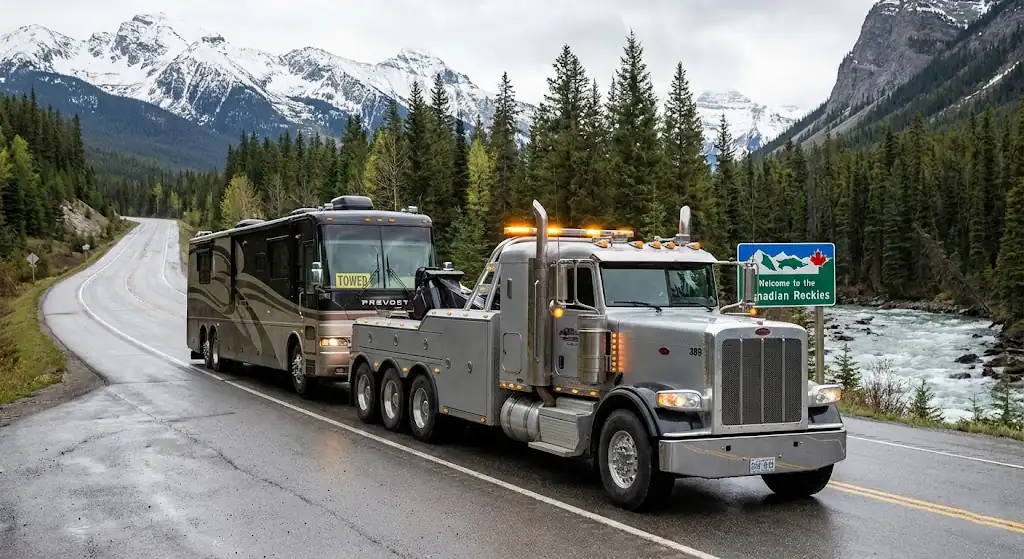
Semi Truck Breakdown in Edmonton: Big Rig Towing, Recovery, and What Drivers and Fleet Managers Need to Know
🚛 Semi Breakdown — Drivers: Do This Now
1) Pull as far onto the shoulder as possible — use the full width. 2) Hazards on, engine off (unless needed for safety lights). 3) Set triangles or flares: 3 m, 30 m, and 60 m behind the trailer. 4) Call dispatch and (780) 435-2065. Tell us: location, truck type, load weight, and what happened. We dispatch heavy duty tow truck equipment rated for your unit.
⚠️ Loaded trailer? Hazmat? Rollover? — Tell us immediately, it changes the equipment we send.
A semi truck breakdown is not like a car breakdown. When a Class 8 tractor-trailer weighing 36,000 kg (80,000 lbs) loaded stops on the Yellowhead, the Henday, or the QEII, you are dealing with a 22-metre vehicle that cannot be pushed to the shoulder, cannot be loaded onto a standard flatbed, and requires specialized big rig towing equipment that most towing companies simply do not have. The load may need to be transferred before the truck can move. The trailer may need separate recovery. And every hour of downtime costs the fleet operator real money — often $150–$500+ per hour in lost revenue, driver wages, and delivery penalties.
This guide is written for two audiences: the driver sitting in the cab of a broken-down semi right now, and the fleet manager coordinating the recovery from the office. We cover the complete big rig towing and recovery process in Edmonton: what equipment is used, what information to provide for fastest dispatch, where semi breakdowns cluster on Edmonton’s road network, what it costs, and how to set up a fleet towing relationship before something goes wrong. Our heavy-duty towing service handles commercial truck recovery daily across Edmonton and Alberta.
🚛 Vehicles That Require Heavy-Duty Towing Equipment
A standard tow truck cannot handle these. Heavy duty tow truck equipment — integrated wreckers, rotators, or heavy-duty winches — is required for any of the following:
🚛 Semi Trucks / Tractor-Trailers
GVWR: 15,000–36,000+ kg
Class 7–8 trucks: day cabs, sleeper cabs, with or without trailers. Includes dry vans, reefers, flatdecks, tankers, and B-trains. These are the majority of our big rig towing calls.
🏗️ Heavy Equipment
Weight varies: 5,000–50,000+ kg
Excavators, loaders, graders, dozers, cranes on transport trailers. Heavy equipment towing often involves both recovering the equipment and the trailer it was being transported on. Common in Nisku and oilfield corridors.
🚌 Buses & Large Commercial
GVWR: 12,000–20,000+ kg
Transit buses, charter coaches, school buses, and large service trucks (water trucks, vacuum trucks, cement mixers). Require medium-to-heavy-duty wreckers depending on configuration.
🚚 Medium-Duty Trucks
GVWR: 6,000–15,000 kg
Cube vans, delivery trucks (Purolator, FedEx, furniture), dump trucks, and straight trucks. Some can be flatbedded; larger units require integrated wreckers.
📞 What to Tell the Dispatcher for a Semi Truck Call
Semi calls require more detail than car calls. The wrong equipment dispatched to a loaded B-train wastes hours. When you call (780) 435-2065, have this ready:
📞 Exact location: Highway, direction, nearest exit or km marker, GPS coordinates if available
📞 Truck type: Day cab, sleeper, straight truck, tandem, tri-axle, B-train
📞 Trailer type: Dry van, reefer, flatdeck, tanker, lowboy, no trailer
📞 Load status: Empty, loaded, approximate weight, hazmat (yes/no)
📞 What happened: Engine failure, tire blowout, brakes locked, electrical, collision, rollover, in a ditch
📞 Is the load secure? Has cargo shifted? Any fluid leaks?
📞 Fleet dispatch contact: If you are a driver, give us your fleet manager or dispatch number so we can coordinate directly
🛣️ Where Semi Trucks Break Down in Edmonton
Commercial truck breakdowns cluster along Edmonton’s freight corridors:
🛣️ Yellowhead Trail (Hwy 16): Edmonton’s primary east-west freight corridor. The ongoing freeway conversion creates lane shifts, temporary barriers, and reduced shoulders that trap disabled trucks. The Anthony Henday interchanges (west and east) and the 170 Street/Fort Road area see the most commercial breakdowns. See our highway breakdown guide for Yellowhead-specific pullover spots.
🛣️ QEII (Hwy 2) south to Leduc/Nisku: The main north-south freight route. Semis heading to/from Leduc, the Nisku Business Park, and the Edmonton airport cargo area break down on this high-speed corridor regularly. Tire blowouts at 110 km/h are the most common call.
🛣️ Anthony Henday Drive: The ring road carries heavy commercial traffic, especially the west section between Yellowhead and Whitemud (concurrent with Hwy 2). The closely spaced interchanges create weaving problems for long combination vehicles. Sherwood Park and Refinery Row exits see frequent commercial calls.
🛣️ Nisku/Airport industrial area: Heavy truck traffic serving the Nisku Business Park, airport cargo facilities, and oilfield supply yards. These are often off-highway calls requiring recovery from industrial roads, yard access lanes, or soft ground.
🛣️ Highway 16 West to Spruce Grove/Edson: Long-haul semis heading to Jasper and BC break down west of Edmonton, especially on sustained grades. Our long-distance towing covers this entire corridor through Spruce Grove and beyond.
🚛 Big Rig Down? We Have the Equipment.
Integrated wreckers • Rotators • Winch-outs • Load transfer • 24/7
🔧 Most Common Reasons Semis Break Down in Edmonton
🔧 Tire blowouts: The #1 call. Semi tires carry massive loads and fail from under-inflation, overloading, heat buildup, or road debris. A steer tire blowout at highway speed is a potential rollover. A drive tire blowout shreds mud flaps and can damage brake lines.
🔧 Engine and cooling system failure: Diesel engines overheat from coolant leaks, failed water pumps, or thermostat failure — especially under load on grades or in summer heat. Turbo failures and injector problems also strand trucks mid-route.
🔧 Air brake system issues: Frozen air lines in winter, compressor failure, and leaking glad-hand connections cause brake lockups or loss of braking. A truck with a brake violation cannot legally continue and must be towed.
🔧 Electrical and DEF system failures: Modern semis rely on complex electrical systems and diesel exhaust fluid (DEF) systems. A DEF system fault can derate the engine to 8 km/h — effectively stranding the truck on a highway.
🔧 Jackknife and rollover: Winter ice, crosswinds on the QEII, and improper braking cause jackknife and rollover incidents that require rotator recovery — the most complex and costly big rig towing scenario.
💰 Semi Truck Towing Cost in Edmonton
Big rig towing costs significantly more than passenger vehicle towing due to the specialized equipment, additional fuel, extended recovery time, and crew requirements. Here are typical 2026 ranges:
All quotes are provided upfront before dispatch — required under Alberta’s 2026 towing consumer protection laws. Fleet accounts with pre-negotiated rates are available — contact us to set one up. For general pricing, see our towing cost guide.
📋 For Fleet Managers: Setting Up Before Something Goes Wrong
The worst time to find a heavy duty tow truck company is during the emergency. Fleet managers who plan ahead save time, money, and stress:
📋 Establish a fleet account now. Pre-negotiated rates, direct billing, and a single phone number your drivers memorize. We offer fleet accounts for trucking companies, construction firms, and oilfield operators. Contact us to set up an account.
📋 Give drivers the tow number. Put our number — (780) 435-2065 — in every truck’s glove box, on the driver’s phone, and in the fleet management system. When a driver breaks down at 2 AM, they should not be searching the internet.
📋 Know your weight classes. Your dispatcher needs to know the approximate GVWR and loaded weight of each unit so the towing company sends the right equipment the first time.
📋 Review your insurance coverage. Commercial auto policies often include towing coverage that differs from personal policies. Confirm limits, deductibles, and whether direct billing is accepted. Read our insurance and towing guide for general coverage information.
🔧 Full Heavy-Duty Services and Resources
🔧 Heavy-duty towing — semis, buses, equipment, commercial vehicles
🔧 Winching — off-road, ditch, and soft-ground recovery for heavy units
🔧 Accident recovery — collision scene clearance including load transfer
🔧 Long-distance towing — semi transport across Alberta and western Canada
🔧 Flatbed towing — for medium-duty trucks and equipment on trailers
🔧 24-hour towing — commercial breakdowns at any hour
🔧 Roadside assistance — battery boost, tire change, fuel delivery for trucks
🔧 All services | Homepage | St. Albert | Read our blog on heavy-duty towing basics and our winter driving guide for cold-weather breakdowns. For Alberta towing regulations, see our laws guide. Check 511 Alberta for road conditions and Alberta.ca commercial vehicle regulations for weight and dimension rules.
Frequently Asked Questions About Semi Truck Towing in Edmonton
How much does big rig towing cost in Edmonton?
A local on-road semi tow typically costs $400–$800. Ditch or off-road recovery runs $500–$1,500+. Rollover recovery with rotator equipment can reach $2,000–$10,000+ depending on complexity. Load transfer adds $500–$2,000+. All quotes are provided upfront before we dispatch.
How fast can you reach a broken-down semi?
Response time for semi towing in the Edmonton area is typically 20–45 minutes depending on the location, time of day, and equipment required. Yellowhead and Henday calls within the city are fastest. Highway calls south toward Leduc or west toward Spruce Grove may take 30–50 minutes. We give you an honest ETA when you call.
What if my trailer is loaded — can you still tow?
It depends on the situation. If the tractor is disabled but the trailer is intact, we can tow the tractor and arrange for another truck to move the trailer. If the trailer itself is damaged or the load has shifted, we may need to perform a load transfer to a second trailer before recovery. Tell us the load weight and type when you call — this determines the equipment and plan.
Do you handle rollover recovery?
Yes. Rollover recovery is one of the most complex operations in big rig towing. It requires rotator cranes (capable of lifting 40–75 tons), precise rigging, and often load removal before the vehicle can be righted. Our heavy-duty team handles these on Edmonton highways and throughout Alberta. Response time is longer than standard tows due to the specialized equipment dispatched.
Can you tow my semi from Edmonton to Calgary?
Yes. Our long-distance towing covers the QEII corridor from Edmonton to Calgary (~300 km) and throughout Alberta. Long-distance semi tow rates run $8–$15/km depending on weight class and loaded status. We quote the exact cost before dispatching.
Do you offer fleet accounts for trucking companies?
Yes. Fleet accounts include pre-negotiated rates, direct billing, a dedicated dispatch number, and priority response. We work with trucking companies, construction firms, oilfield operators, and any business with commercial vehicles. Contact us to set up an account before you need one.
What should the driver do while waiting for the heavy tow truck?
Set warning triangles at 3 m, 30 m, and 60 m behind the trailer (required by law for commercial vehicles). Stay in the cab with seatbelt on. Keep hazards on. Do not attempt roadside repairs on a live highway. Contact your fleet dispatcher. Monitor for any fluid leaks, smoke, or cargo movement and report changes to us when we call back with an ETA.
Is heavy-duty towing available 24/7?
Yes. Heavy duty tow truck service operates 24 hours a day, 7 days a week. Commercial breakdowns happen at all hours — a reefer trailer with perishable cargo at 3 AM cannot wait until morning. Call (780) 435-2065 anytime.
Do you handle heavy equipment towing too?
Yes. Heavy equipment towing — excavators, loaders, graders, cranes, and construction machinery — is part of our heavy-duty service. Whether the equipment broke down on a trailer during transport or needs recovery from a job site, our heavy-duty fleet handles it.
What areas do you cover for semi truck towing?
All of Edmonton and the greater metro area, all major highway corridors (Yellowhead, Henday, QEII, Whitemud), and long-distance throughout Alberta. Service areas include Sherwood Park, St. Albert, Spruce Grove, Leduc, Nisku, and beyond.
Big Rig Down? We Have the Iron to Move It.
Integrated wreckers • Rotators • Heavy winch • Load transfer • 24/7 • Fleet accounts